
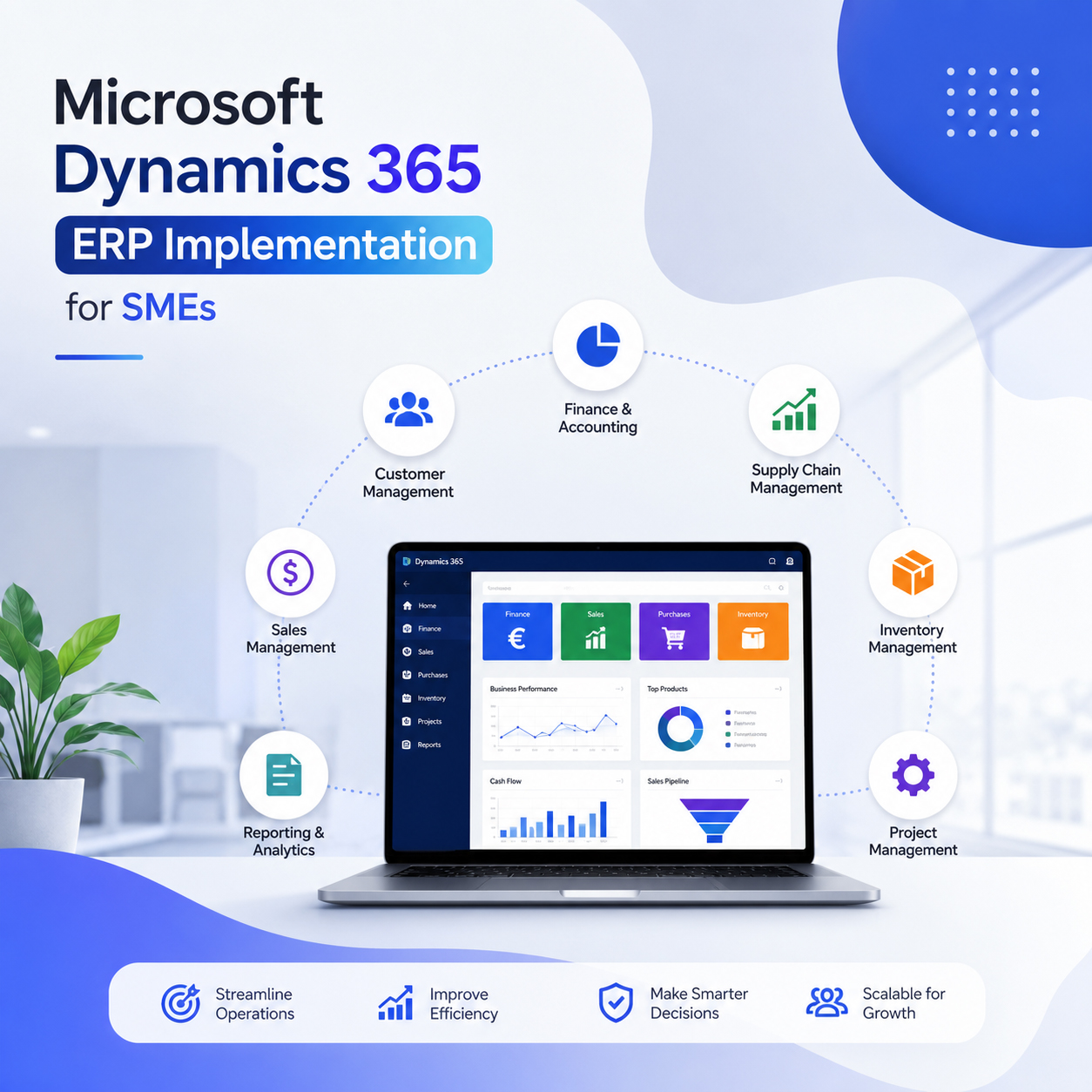
Microsoft Dynamics 365 ERP Implementation for SMEs
Businesses across Europe are embracing digital transformation to improve productivity, automate operations, and remain competitive in rapidly changing markets. Small and medium-sized enterprises need modern solutions that simplify finance, inventory, sales, procurement, customer management, and reporting while keeping operational costs under control. A cloud-based enterprise management platform provides flexibility, security, and scalability that traditional systems cannot easily match.
Microsoft Dynamics 365 ERP Implementation for SMEs helps organizations integrate every critical business function into a single intelligent platform. Whether you operate in manufacturing, wholesale, retail, logistics, healthcare, education, or professional services, this ERP solution enables better collaboration, real-time reporting, and informed decision-making.
Companies seeking reliable implementation support can also explore Microsoft ERP services at https://hrsoftwaresolution.com/microsoft-erp along with complete enterprise solutions available on https://hrsoftwaresolution.com/.
Why Microsoft Dynamics 365 ERP Implementation for SMEs Matters
A successful Microsoft Dynamics 365 ERP Implementation for SMEs enables organizations to eliminate manual processes and connect every department through one cloud platform.
Major benefits include:
- Centralized business data
- Real-time financial reporting
- Automated accounting
- Inventory optimization
- Purchase management
- Sales automation
- Supply chain visibility
- Customer relationship integration
- Multi-location management
- Regulatory compliance
- Cloud accessibility
- AI-powered business insights
- Lower operational costs
- Faster business decisions
- Secure Microsoft Cloud infrastructure
European SMEs benefit from local tax compliance, multilingual capabilities, multi-currency support, and simplified international trade management.
Key Features of Microsoft Dynamics 365 ERP Implementation for SMEs
A professionally planned Microsoft Dynamics 365 ERP Implementation for SMEs includes several integrated business modules designed to improve efficiency.
Financial Management
The finance module automates accounting, budgeting, taxation, cash flow monitoring, accounts payable, accounts receivable, bank reconciliation, and financial forecasting while providing real-time dashboards.
Inventory and Warehouse Management
Businesses gain complete inventory visibility through automated stock updates, barcode integration, warehouse management, reorder planning, demand forecasting, and stock movement tracking.
Procurement Management
Purchase approvals, vendor management, quotation comparisons, purchase orders, invoice verification, and supplier performance reporting become significantly more efficient.
Sales Management
Sales teams can manage quotations, customer orders, invoices, pricing rules, customer communication, and revenue forecasting from a unified platform.
Manufacturing Operations
Manufacturers can monitor production planning, bills of materials, production scheduling, quality control, machine utilization, and resource planning.
Project Management
Professional service firms can monitor project budgets, resource allocation, project profitability, billing, milestones, and timelines from one dashboard.
Benefits of Microsoft Dynamics 365 ERP Implementation for SMEs in Europe
European organizations increasingly adopt Microsoft Dynamics 365 ERP Implementation for SMEs because of its flexibility and long-term scalability.
Benefits include:
- Cloud-first architecture
- GDPR-ready security features
- Multi-language support
- Multi-currency transactions
- VAT compliance
- Faster reporting
- Improved employee collaboration
- Mobile accessibility
- Business intelligence integration
- AI-powered forecasting
- Reduced IT maintenance
- Better customer experiences
- Improved operational transparency
- Business scalability
- Microsoft ecosystem integration
These advantages make the platform suitable for growing companies across Germany, France, Spain, Italy, the Netherlands, Belgium, Ireland, Austria, Portugal, Finland, and other European markets.
Industries Using Microsoft Dynamics 365 ERP Implementation for SMEs
Organizations across multiple industries successfully implement this ERP solution.
Popular sectors include:
- Manufacturing
- Wholesale Distribution
- Retail
- Healthcare
- Pharmaceutical
- Construction
- Education
- Food Processing
- Logistics
- Engineering
- Automotive
- Textile
- Hospitality
- Financial Services
- Professional Consulting
Microsoft Dynamics 365 ERP Implementation Process
A structured implementation minimizes business disruption and maximizes ROI.
Typical implementation stages include:
Business Analysis
Business processes are evaluated to identify inefficiencies, opportunities, and future scalability requirements.
Requirement Planning
Implementation consultants define workflows, modules, integrations, reporting needs, and migration strategies.
System Configuration
ERP modules are configured according to business operations while maintaining Microsoft best practices.
Data Migration
Legacy financial records, inventory data, customer databases, suppliers, employees, and historical transactions are migrated securely.
User Training
Employees receive comprehensive training to ensure smooth adoption and increased productivity.
Testing and Go-Live
The ERP system undergoes multiple testing phases before production deployment to reduce implementation risks.
Ongoing Support
Continuous optimization, updates, monitoring, and technical support ensure long-term success.
Microsoft Dynamics 365 ERP Implementation for SMEs vs Traditional ERP
Traditional ERP systems often require expensive servers, infrastructure, hardware upgrades, and complex maintenance.
In contrast, Microsoft Dynamics 365 ERP Implementation for SMEs offers:
- Cloud deployment
- Automatic software updates
- Subscription-based pricing
- Remote accessibility
- Microsoft Azure security
- AI-powered automation
- Lower maintenance costs
- Faster implementation
- Better scalability
- Easier third-party integrations
These advantages help SMEs achieve faster digital transformation without significant upfront investments.
Integration with Business Applications
Microsoft Dynamics integrates seamlessly with several Microsoft and third-party business tools.
Supported integrations include:
- Microsoft 365
- Microsoft Teams
- Outlook
- Power BI
- Power Automate
- SharePoint
- Azure
- CRM solutions
- HR systems
- Payroll software
- Banking platforms
- E-commerce platforms
Businesses can further strengthen digital transformation by integrating services from:
- IT Staffing Solutions: https://hrsoftwaresolution.com/it-staffing-solutions
- SAP ERP: https://hrsoftwaresolution.com/sap-erp
- Odoo ERP: https://hrsoftwaresolution.com/odoo-erp
- Software Development: https://hrsoftwaresolution.com/software_development
- Mobile App Development: https://hrsoftwaresolution.com/mobile_app_development
- IT Infrastructure: https://hrsoftwaresolution.com/IT_Infrastructure
Best Practices for Successful Microsoft Dynamics 365 ERP Implementation for SMEs
To maximize implementation success:
- Define measurable business goals.
- Document existing workflows.
- Prepare clean business data.
- Involve key stakeholders.
- Train employees before deployment.
- Test every business process.
- Monitor post-implementation performance.
- Use certified implementation experts.
- Plan future scalability.
- Continuously optimize ERP workflows.
Why Choose Professional Microsoft Dynamics 365 ERP Implementation Services
Professional ERP consultants reduce implementation risks while accelerating deployment.
Advantages include:
- Faster implementation
- Industry-specific expertise
- Secure data migration
- Customized workflows
- Better ROI
- Reduced downtime
- Employee training
- Continuous technical support
- Performance optimization
- Future-ready cloud architecture
Conclusion
Microsoft Dynamics 365 ERP Implementation for SMEs empowers European businesses to modernize operations, improve financial control, automate business processes, and achieve sustainable growth. Its cloud-first architecture, intelligent analytics, seamless Microsoft integration, and enterprise-grade security make it one of the most reliable ERP platforms for small and medium-sized businesses.
Organizations planning digital transformation can combine Microsoft ERP with IT infrastructure, software development, mobile applications, and staffing services to build a complete business technology ecosystem.
External Resources
- Google Search Console: https://search.google.com/search-console
- Google PageSpeed Insights: https://pagespeed.web.dev/
- Google Analytics: https://analytics.google.com/
- W3C Standards: https://www.w3.org/
- Google Business Profile: https://business.google.com/
- Google Search Documentation: https://developers.google.com/search/docs
- MDN Web Docs: https://developer.mozilla.org/
- Schema.org: https://schema.org/
Leave a Reply